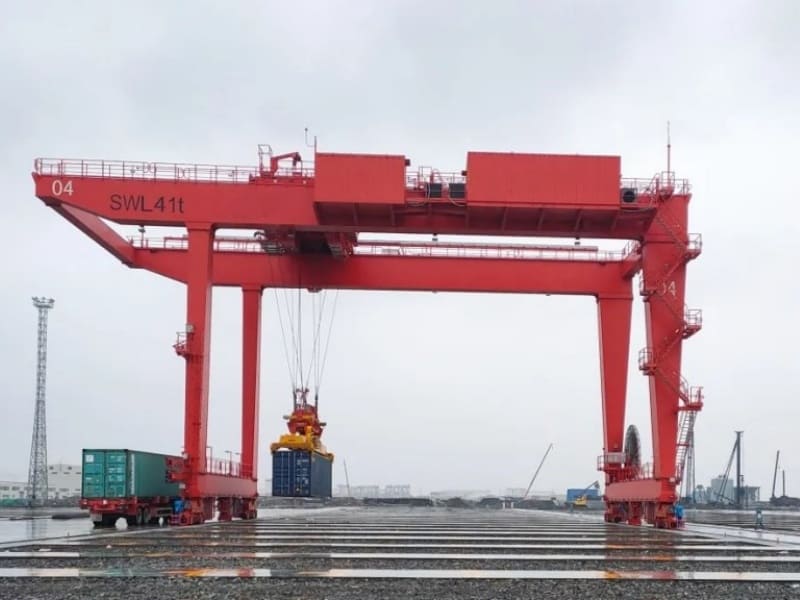
Container gantry cranes are engineered to deliver high efficiency, stability, and adaptability in demanding material handling environments such as ports, yards, and industrial facilities. Their design integrates robust structural components with advanced lifting and control systems.
Key features include:
♦Robust Structural Design
The heavy duty gantry crane consists of a horizontal main girder supported by vertical legs, forming a stable gantry structure. Depending on the application, it can be configured as a full gantry crane, where both legs travel on rails or wheels, or as a semi-gantry crane, where one side runs on a rail while the other is supported by an elevated runway. The structure is typically fabricated from high-quality steel or aluminum, ensuring excellent strength, durability, and resistance to corrosion.
♦Flexible Mobility and Configurations
Heavy duty gantry cranes are available in multiple configurations to suit different operational needs. Rubber tyred gantry cranes (RTG) offer high mobility and are ideal for container yards and open storage areas. Rail mounted gantry cranes (RMG) provide precise and stable movement along fixed tracks, making them suitable for ports and factories. Portable gantry cranes are lightweight and adjustable, designed for workshops and temporary lifting applications.
♦Wide Load Capacity and Span Range
These heavy duty gantry cranes are capable of handling a broad range of lifting capacities, from small-scale operations of around 1 ton to heavy-duty applications exceeding 1,000 tons. Span lengths can be customized according to site requirements, typically ranging from 5 meters for compact workshops to over 50 meters for large shipyards or container terminals.
♦Advanced Lifting and Control Systems
The lifting mechanism usually includes electric wire rope hoists or chain hoists mounted on a trolley that travels along the girder. For specialized tasks, additional attachments such as grabs, spreaders, or magnets can be integrated. Optional features like remote control operation, cabin control, and automated positioning systems further enhance precision, safety, and operational efficiency.
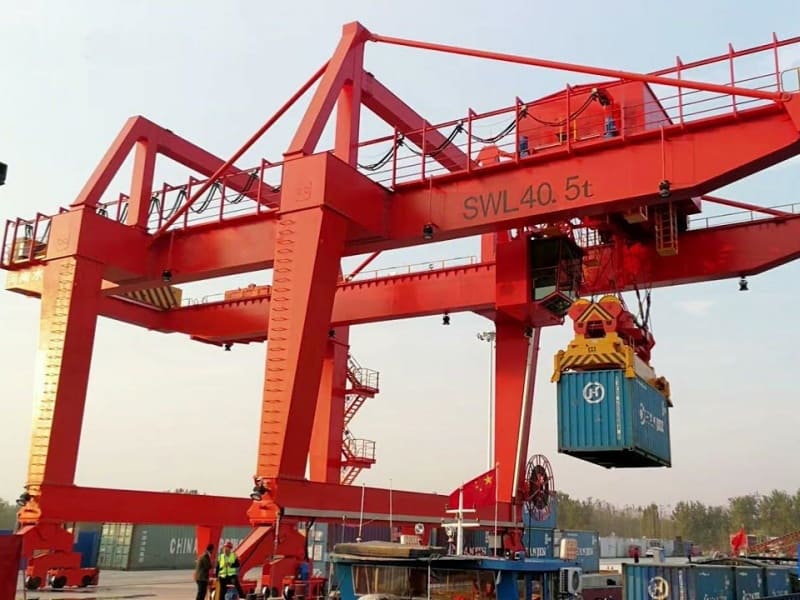
Before a container gantry crane is put into operation, thorough preparation is essential to ensure safe installation, accurate performance, and long-term reliability. A well-planned pre-installation process helps avoid operational issues, reduces risks, and ensures the crane meets all technical and safety requirements.
The key preparation steps include:
♦Site Preparation
Before install container gantry crane, must be carefully assessed and prepared in advance. This includes evaluating soil bearing capacity, checking for potential settlement risks, and ensuring the ground is level and stable. The working area should be cleared of obstacles and debris, with proper drainage systems in place to prevent water accumulation. Safe access routes for transport and lifting equipment must be arranged, while safety measures such as fencing, warning signs, and lighting should be installed to create a secure working environment. It is also important to confirm underground utilities and obtain all necessary permits before construction begins.
♦Foundation Preparation
The foundation must be designed to support both static and dynamic loads generated during container gantry crane operation. Typically, a reinforced concrete foundation is constructed on a compacted base layer. High-strength reinforcement bars are used to ensure structural stability and prevent cracking. Anchor bolts must be accurately positioned according to design specifications, as they are critical for securing the crane structure. After curing, the foundation surface must meet strict level tolerances to ensure proper rail installation and crane alignment.
♦Rail Installation Preparation
The runway system requires precise alignment to guarantee smooth container gantry crane movement. Rails are installed on prepared base plates and adjusted using shims to achieve exact horizontal and vertical alignment. Precision tools such as laser levels are used to control deviations within allowable limits. Rail joints must be welded and polished to ensure seamless travel, and fastening systems are installed to prevent displacement during operation.
♦Power Supply and Cabling Preparation
A reliable electrical system must be arranged before commissioning. Power can be supplied through conductor rails or cable reel systems, depending on project requirements. All cables should be routed properly using trays or conduits, avoiding sharp bends, heat sources, and mechanical interference. Grounding, surge protection, and control system connections must be completed to ensure safe and stable electrical performance.
With the development of intelligent and automated technologies, container gantry cranes are upgrading towards remote control and unmanned operation, further improving operational safety and efficiency, reducing labor costs, and providing strong guarantees for the efficient operation of global container transportation.