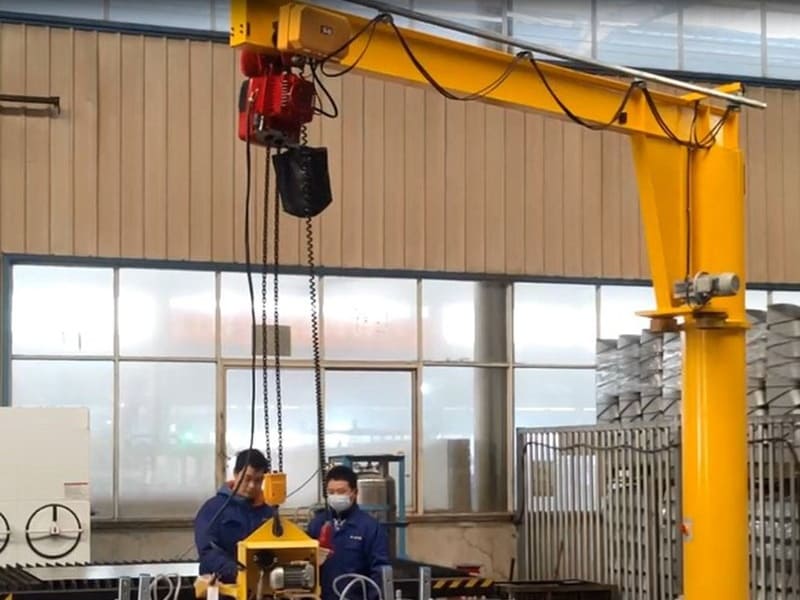
A pillar jib crane is a lightweight and highly efficient lifting solution designed for material handling within limited spaces. It features a fixed vertical column that supports a rotating horizontal arm, combined with an electric hoist to achieve both vertical lifting and horizontal movement. Load capacities typically range from 0.25 tons to 10 tons, making the crane suitable for a wide variety of applications. This design allows for precise and flexible operations, making it ideal for workshops, warehouses, and production lines.
The core structure of a pillar jib crane includes four main components:
Column: Serves as the main support structure of th pillar jib crane, securely anchored to a concrete foundation to bear the load and ensure stability.
Jib Arm: Typically made of I-beam steel, with lengths ranging from 2 to 10 meters, providing a wide working radius.
Slewing Mechanism: Enables smooth rotation of the jib arm, either manually or electrically, allowing full or partial coverage of the working area.
Hoisting Unit: Usually an electric chain hoist or wire rope hoist, responsible for lifting and lowering loads with precision.
Installation and Commissioning Key Points
Proper installation is essential for safe and reliable performance:
Foundation Preparation: For floor mounted jib cranes, a reinforced concrete foundation must be constructed to withstand the rated load and overturning forces.
Assembly Process: Install and align the column vertically first, followed by the jib arm and hoist. Ensure the trolley moves smoothly along the beam. Then install the slewing mechanism and check gear alignment.
Testing and Calibration: After installation, test the crane’s rotation to ensure smooth operation. Perform at least three no-load test runs to verify lifting, traveling, and braking functions. A static load test at 125% of rated capacity should be conducted for 10 minutes to confirm structural integrity.
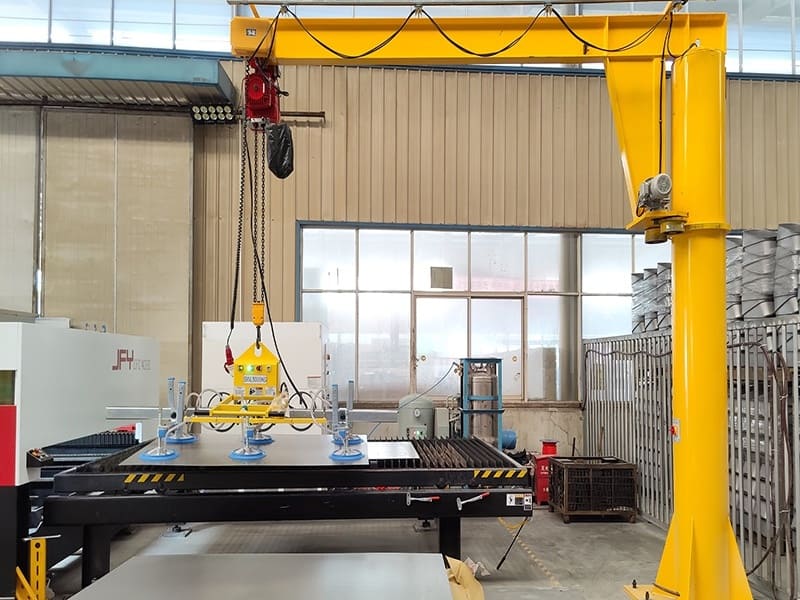
Standard Operating Guidelines
To ensure safe and efficient use, operators should follow these practices:
Before Operation: Check that the load does not exceed the rated capacity. Clear all obstacles within the working radius and ensure safety devices such as limit switches and brakes are functioning properly.
During Operation: Lift loads smoothly and avoid sudden acceleration or stopping. Keep loads at a safe height (generally within 0.5 meters when moving). Avoid side pulling, overloading, or lifting hazardous materials. Always keep the load path clear of personnel.
After Operation: Lower the load completely, park the jib arm of the floor mounted jib crane in a designated position, and disconnect the power supply. Clean dust and oil from the equipment surface.
Maintenance Schedule
Regular maintenance ensures long-term performance and safety:
Daily Maintenance: Clean debris from tracks, inspect wire ropes for wear or breakage, check hooks for deformation, and lubricate key moving parts.
Monthly Maintenance: Tighten all bolts, test limit switches, inspect cables for damage, and replenish lubrication where needed.
Quarterly Maintenance: Verify load limiter accuracy, test emergency stop functions, and inspect gear wear conditions.
Annual Maintenance: Conduct comprehensive inspections, including weld testing, replacement of worn wire ropes and seals, and full calibration of safety systems.
Core Value and Benefits
The freestanding jib crane delivers outstanding value through its combination of efficiency, compact design, and cost-effectiveness:
Space Efficiency: Optimized for small working areas, reducing wasted space and improving layout utilization.
High Productivity: Enables single-operator handling, replacing manual labor and increasing efficiency by over 60%.
Low Operating Cost: Lightweight structure and simple maintenance requirements reduce long-term expenses.
Reliable Performance: With proper installation, operation, and maintenance, the freestanding jib crane provides stable and safe lifting for years.
In essence, a freestanding jib crane achieves the perfect balance between safety, efficiency, and cost in localized lifting operations. By selecting the right model, following proper operating procedures, and maintaining the equipment regularly, businesses can significantly enhance their material handling capabilities while keeping operational risks under control.