
Single Girder Top Running Bridge Crane with Convenient Maintenance
Overview
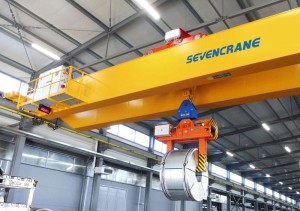
Top running bridge cranes are an ideal lifting solution for applications that require long spans, high lifting capacity, and maximum hook height. Compared with other crane configurations, top running cranes can more easily achieve wider bridge spans and greater lifting heights. The increased hook height provides additional headroom, making them well suited for handling large or bulky loads in facilities with demanding lifting requirements.
A top running overhead crane operates on a fixed rail system installed on top of the runway beams. The end trucks travel along these rails, carrying the crane bridge and hoist smoothly across the workspace. Depending on application needs, top running cranes can be configured as single girder or double girder designs. Single girder cranes typically use an under-running trolley and hoist, while double girder cranes usually feature a top running trolley and hoist for higher capacities and improved lifting performance.
One of the major advantages of top running cranes is their wide capacity range. They can be designed for light-duty applications or engineered to handle extremely heavy loads, with lifting capacities ranging from as low as ¼ ton to over 100 tons. Supported by building structures or dedicated runway columns, these cranes are ideal for heavy industrial environments.
Top running cranes also offer excellent headroom utilization, especially in double girder configurations, where the hoist and trolley run on top of the girders, providing an additional 3 to 6 feet of hook height. Their rail-supported design simplifies installation and maintenance, making them a reliable and efficient choice for long-term industrial use.


Key Terminology
To help users better understand the specifications and structure of a top running bridge crane, the following glossary explains commonly used technical terms. Becoming familiar with these components will make it easier to evaluate crane configurations, discuss requirements with engineers, and select the most suitable overhead crane system for your facility.
♦Bridge Girder: The bridge girder is the main horizontal beam of the crane. It spans the width of the crane runway and supports the trolley and wire rope hoist, carrying the load during lifting and travel operations.
♦Crane Rail: Crane rails are fixed tracks installed on structural steel or concrete runway beams. The end trucks travel along these rails, allowing the top running bridge crane to move longitudinally across the workspace.
♦Crane Runway: The crane runway includes the rails, beams, brackets, and supporting framework on which the overhead crane operates. It provides the structural foundation necessary for smooth and safe crane movement.
♦Wire Rope Hoist: The wire rope hoist is the primary lifting mechanism, responsible for raising and lowering loads. It is designed for heavy-duty operation and provides reliable, controlled lifting performance.
♦Trolley: The trolley carries the hoist and moves laterally along the bridge girder. This movement allows precise positioning of the load across the crane span.
♦End Truck: End trucks support the bridge girder and house the wheels that run on the crane rails, enabling the crane to travel along the runway.
♦Rated Capacity: Capacity refers to the maximum weight the crane is designed to lift safely. Selecting the correct capacity is essential for safe and efficient operation.
Understanding these terms helps ensure clear communication and confident decision-making when selecting a top running bridge crane system.


Features
♦High Reliability and Low Lifecycle Cost: Top running single girder bridge cranes are ideal for applications where long-term reliability and reduced maintenance costs are a priority. Their robust design and proven components ensure stable performance over extended service life.
♦High Traveling Speed: Compared with underhung cranes, top running single girder cranes are capable of higher traveling speeds, often reaching up to 200 feet per minute (fpm). This enables faster material handling and improved workflow efficiency in busy industrial environments.
♦Excellent Headroom Utilization: The crane’s structural configuration provides excellent headroom, maximizing lifting height within existing building constraints. This makes it especially suitable for facilities where vertical space is limited but efficient lifting is required.
♦Wide Capacity and Span Range: Available in lifting capacities from 1 to 20 tons, with spans that can exceed 85 feet, these cranes can be adapted to a wide range of applications, from light manufacturing to medium-duty industrial operations.
♦Preassembled and Tested Delivery: Powered overhead single girder cranes can be shipped partially or fully preassembled. Each unit undergoes operational inspection and functional testing before leaving the factory, reducing installation time and on-site commissioning work.
♦Safe and Flexible Control Options: The top running bridge crane can be equipped with remote controls or pendant controls running on independent tracks, allowing operators to maintain a safe distance from suspended loads while ensuring precise operation.
♦Fast Lead Time with Pre-Engineered Designs: Many standard sizes and capacities are pre-engineered, enabling faster production and shorter delivery times to meet urgent project schedules.