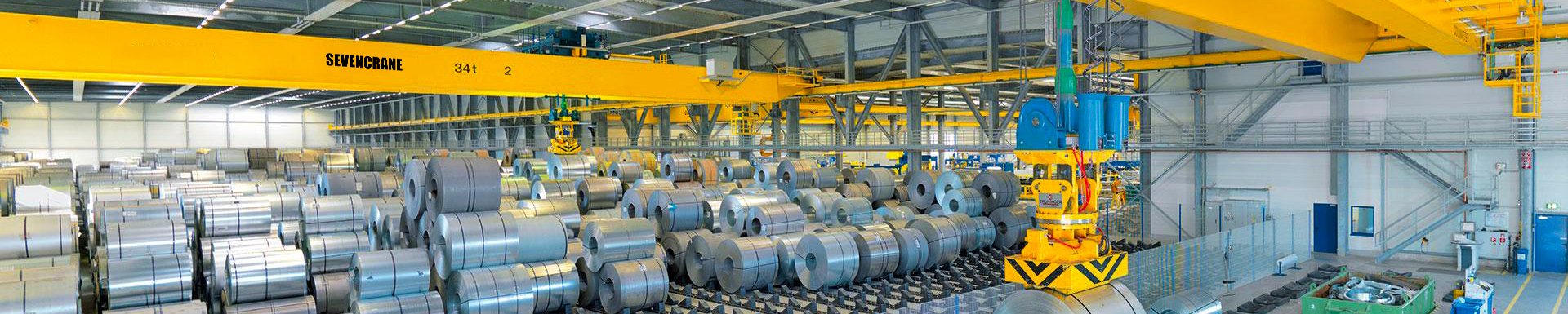

Affordable 10 Ton Top Running Bridge Crane for Industrial Use
Optional Features for Top Running Bridge Crane
♦Dual Speed Hoist and Trolley
The top running bridge crane is equipped with variable frequency drive (VFD) technology for both hoist lifting and trolley travel. Adjustable speeds provide smooth acceleration and deceleration, reducing load swing and improving positioning accuracy. This feature enhances operational efficiency while minimizing mechanical wear.
♦Radio Remote Controls
A wireless radio control system is provided with one 120 VAC receiver and two transmitters. Each transmitter is equipped with six two-speed pushbuttons for three motions, along with Start, On/Off, and Emergency Stop functions. The control package includes a protective rubber boot, padded carrying case, retractable belt clip, and other accessories for convenient operation and storage.
♦Independent Walk-Away Pendant
An independent pendant control station is supplied with a rigid-track festoon system. This allows operators to control the crane safely while maintaining a suitable working distance from the load and operating area.
♦Trolley End-of-Travel Protection
Limit switches are installed on the hoist trolley to provide automatic slowdown and stop functions when approaching the trolley end stops. Indicator lights mounted on the crane notify operators whenever the protection system is activated, improving safety and reducing impact forces.
♦Bridge Travel Slowdown and Stop System
Photoelectric sensors are mounted on the top running bridge crane to detect the approach to the end of the runway. The system automatically slows and stops bridge travel before reaching the runway end stops. Signal lights are provided to indicate system activation and ensure safe crane operation.
♦Crane-to-Crane Anti-Collision System
For applications with multiple cranes operating on the same runway, an anti-collision system is available. The sensors detect obstacles or adjacent cranes and automatically reduce travel speed when the distance reaches approximately 4.5 m. If the distance decreases to about 0.9 m, bridge travel is stopped automatically. The warning distance can be adjusted on site, and indicator lights are installed on the control panel to display system status. A reflector and mounting bracket are included for installation on the opposing crane or fixed obstruction.


Advantages of Top Running Bridge Crane
♦Cost-Effective Design
Top running bridge cranes feature a simple and efficient structural design, resulting in lower manufacturing costs, reduced freight expenses, and faster installation. Less material is required for bridge and runway construction, making the system an economical lifting solution.
♦Suitable for Light to Medium Duty Applications
These cranes provide an excellent balance between performance and investment. They are widely used for light and medium-duty material handling tasks and offer reliable operation with low operating costs.
♦Reduced Structural Requirements
With a relatively low deadweight, top running bridge cranes impose less load on building structures and foundations. In many cases, the crane can be supported by existing steel structures, eliminating the need for additional support columns and reducing construction expenses.
♦Excellent Hook Approach
The design allows for improved hook approach in both bridge and trolley travel directions, maximizing the usable lifting area and making it easier to handle loads efficiently within limited workspace.
♦Easy Installation and Maintenance
Top running bridge cranes are designed for convenient installation, inspection, and servicing. Their accessible components simplify routine maintenance, reduce downtime, and help extend equipment service life.
♦Wide Range of Applications
These cranes are suitable for various industries and environments, including workshops, warehouses, fabrication plants, material yards, and manufacturing facilities. Their versatility makes them an ideal choice for general-purpose lifting operations.
♦Reduced Wear and Longer Service Life
The lighter overall weight places lower stress on runway beams, rails, and end truck wheels. Reduced wheel loads help minimize component wear, resulting in lower maintenance costs and longer service life for both the crane and supporting structures.
♦Reliable and Efficient Material Handling
Top running bridge cranes provide smooth operation, dependable performance, and high working efficiency, making them an ideal solution for improving productivity and ensuring safe material handling.


Packing and Shipping
♦Protected Packaging for Electrical Components
All sensitive electrical components, including control panels and electrical accessories, are packed in fumigated plywood crates with shockproof and moisture-resistant materials. This packaging method effectively protects the equipment from vibration, impact, and humidity during long-distance transportation and ocean shipping.
♦Secure Packaging for Structural Components
Main girders, end trucks, and hoist trolleys are carefully wrapped with heavy-duty woven cloth and protective films. These materials help prevent scratches, paint damage, corrosion, and other surface defects, ensuring the crane arrives in excellent condition.
♦Flexible Transportation Solutions
Depending on the crane dimensions and customer requirements, various shipping methods are available. Compact models can be transported in standard containers, while larger cranes can be shipped in partially disassembled sections or by bulk carriers. This flexibility allows us to accommodate different project requirements while optimizing transportation efficiency.
♦Optimized for Safety and Cost Efficiency
Our packaging and logistics plans are designed to provide maximum protection with minimum transportation costs. Every component is arranged carefully to make full use of container space, helping customers reduce freight expenses without compromising safety.
♦Professional Loading and Delivery Support
Before shipment, each component is clearly marked and secured to ensure safe loading and unloading. Our experienced logistics team provides complete support for cargo loading, packing lists, commercial documents, and customs clearance procedures, ensuring a smooth delivery process.
♦Worldwide Shipping Experience
With extensive experience in exporting overhead cranes to customers around the world, we provide reliable and efficient shipping services. Every top running bridge crane is delivered with careful attention to quality, safety, and customer satisfaction, ensuring that the equipment reaches the installation site ready for assembly and operation.
-
Customizable Double Girder Overhead Cranes Tail...
-
Indoor 1T 2T 3T Underhung Bridge Crane With Ele...
-

Workshop Application Double Girder Overhead Cra...
-

Workshop Roof Top Running Bridge Crane for Safe...
-

Lifting Equipment Single Girder Overhead Crane ...
-

China Factory Price 15 Ton Single Girder Overhe...