
Good Service Customized Double Girder Overhead Crane for Sale
Overview
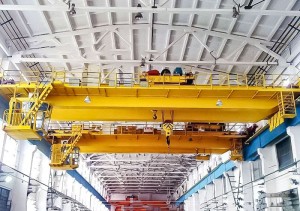
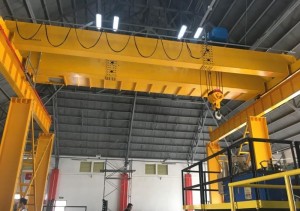
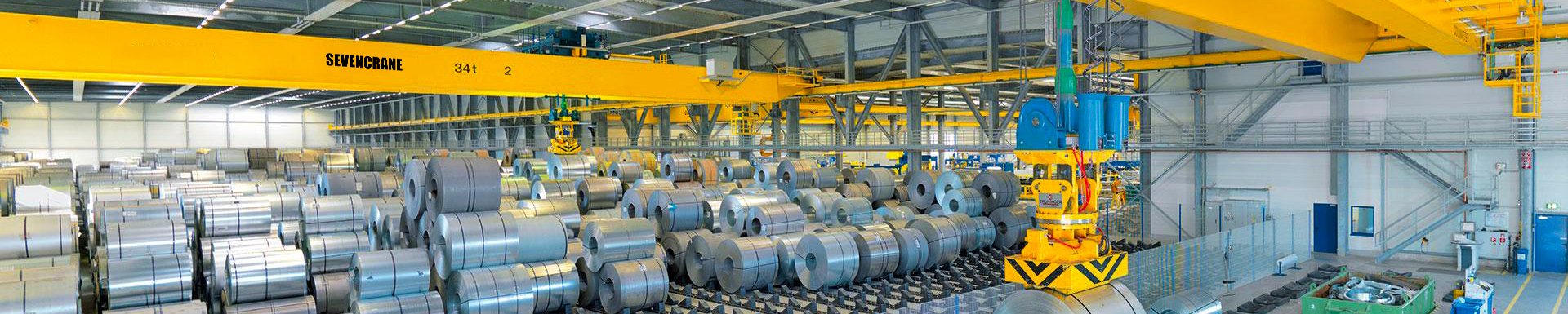
A double beam bridge crane is a heavy-duty lifting solution designed for efficient material handling in workshops, warehouses, manufacturing plants, and storage yards. The crane mainly consists of two bridge girders, a hoisting mechanism, an electric trolley, a traveling system, and an electrical control system. The trolley runs smoothly along rails mounted on the girders, enabling precise lifting and positioning of heavy loads. With its robust structure and excellent load-bearing capacity, the crane is particularly suitable for applications that require frequent operation, high lifting capacities, and long service life.
The bridge crane travels along runway beams installed on both sides of the building, making full use of the available workspace below. This design allows materials to be transported efficiently without interfering with ground-level equipment or production activities. Depending on operational requirements, the crane can be controlled by a pendant controller, wireless remote control, or operator cabin. Additional options such as variable frequency drives, air-conditioning systems, warning devices, and communication equipment can also be provided. Thanks to its stable performance, high working efficiency, and flexible configuration options, the double beam bridge crane is one of the most widely used lifting systems in modern industrial facilities.


Main Components of Double Girder Overhead Crane
♦Hoist and Trolley Assembly: The hoisting system is the core lifting mechanism of the crane. It consists of an electric hoist mounted on a trolley that travels along the bridge girders. This assembly enables the lifting, lowering, and horizontal movement of loads with high precision. The trolley’s smooth operation allows materials to be positioned accurately, improving handling efficiency and workplace productivity.
♦Double Bridge Girders: The bridge structure is composed of two heavy-duty girders that provide the crane with exceptional strength and stability. Manufactured from high-quality steel, the girders are designed to withstand heavy loads and continuous operation. Their robust construction ensures reliable performance, reduced structural deformation, and a long service life in demanding industrial environments.
♦End Carriages: Installed at both ends of the bridge girders, the end carriages support the entire crane structure and enable longitudinal travel along the runway rails. Equipped with wheels, drive units, and transmission components, they ensure smooth, stable, and accurate movement throughout the working area while maintaining operational safety.
♦Electrical Control System: The electrical system controls lifting, trolley travel, crane travel, and safety functions. Advanced control technology helps achieve precise operation, smooth speed regulation, and reliable performance. The system can also be integrated with overload protection, limit switches, emergency stop functions, and other safety devices to enhance operational security.
♦Control Devices: Various control methods are available to meet different operational requirements. Operators can choose from pendant controls, wireless remote controls, or fully enclosed operator cabins. These options provide flexibility, improve working comfort, and enable efficient crane operation in a wide range of industrial applications.
♦Power Supply and Safety Devices: The double girder overhead crane is equipped with a power supply system and multiple safety components, including travel limit switches, overload protection systems, warning alarms, and emergency stop devices. These features help ensure safe, reliable, and uninterrupted operation throughout the crane’s service life.


Characteristics of Double Girder Overhead Crane
♦Robust Box Girder Construction
The main girders are designed with a reinforced box-type structure that provides excellent strength, rigidity, and stability. The bridge components are connected using high-strength bolts, allowing convenient transportation, installation, and future maintenance while ensuring reliable long-term performance.
♦Advanced Integrated Drive System
The crane adopts an integrated drive mechanism that combines the motor, gearbox, and brake into a compact unit. This design improves transmission efficiency, reduces mechanical wear, minimizes operating noise, and ensures smooth and dependable movement of both the trolley and crane.
♦Compact Structure and Reduced Weight
By utilizing optimized structural design and high-quality materials, the crane achieves a lighter overall weight while maintaining excellent load-bearing capacity. The compact configuration reduces wheel loads and building requirements, helping customers lower workshop construction and operating costs.
♦Modular Engineering Design
The modular design concept improves production efficiency and component standardization. Standardized parts simplify manufacturing, installation, maintenance, and future upgrades while ensuring excellent interchangeability between components.
♦Intelligent Variable Frequency Control
Variable frequency drive (VFD) technology enables precise speed regulation during lifting and traveling operations. The crane accelerates and decelerates smoothly, reducing impact loads, minimizing equipment vibration, and improving operator control. This also contributes to lower energy consumption and longer equipment life.
♦Stable and Efficient Performance
The optimized control system provides smooth trolley and bridge travel with reduced load sway. Whether handling heavy loads or performing precise positioning tasks, the crane maintains stable operation and high working efficiency, making it suitable for demanding industrial environments.
♦Heavy-Duty Working Capability
Designed for continuous and intensive service, the double girder overhead crane is capable of meeting high-duty operational requirements. Its reliable performance, durable construction, and advanced control technology make it an ideal solution for modern material handling applications.