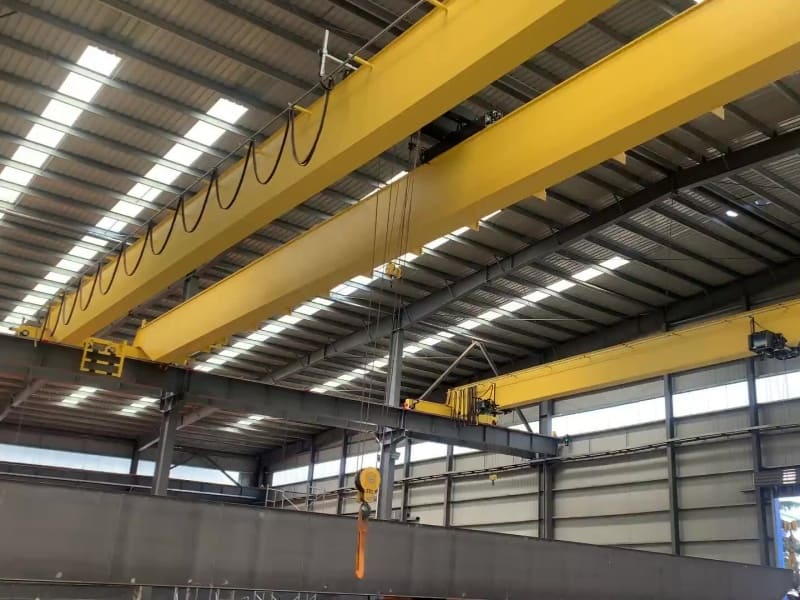
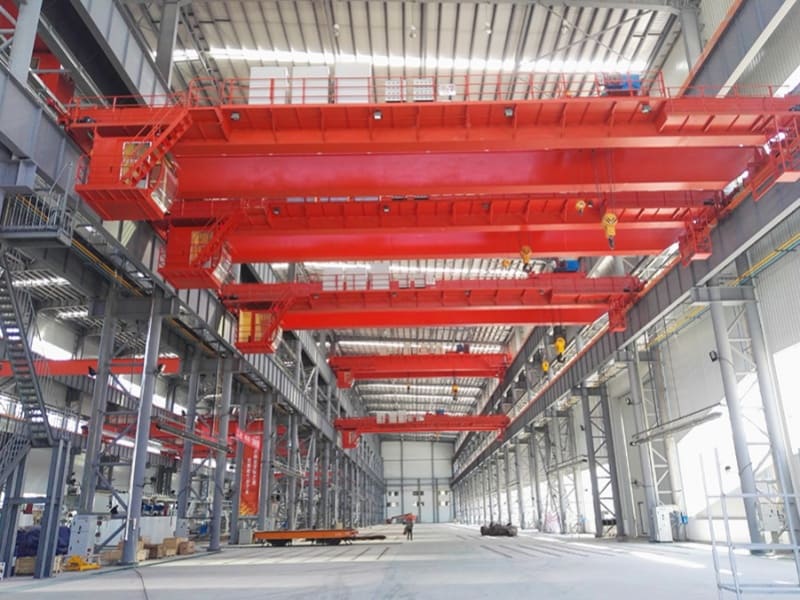
A double girder overhead crane is a heavy-duty lifting solution widely used for handling materials in workshops, warehouses, and industrial yards. It features two main girders mounted on end trucks, forming a bridge-like structure that travels along rails installed on elevated supports such as concrete columns or steel frameworks. This design allows the crane to operate efficiently across large spans while maintaining excellent stability and load-bearing capacity.
The crane bridge moves longitudinally along the runway tracks, while a trolley travels across the two girders, enabling precise positioning of loads. This dual-direction movement makes it possible to fully utilize the space below the crane, as materials can be lifted and transported without interference from ground-level equipment. Compared to single girder cranes, the double girder design offers higher lifting capacity, greater working efficiency, and improved durability.
Due to its robust structure and reliable performance, the double girder overhead crane is especially suitable for industries that require frequent and intensive lifting operations. It is commonly used in manufacturing plants, steel processing facilities, heavy equipment workshops, and logistics centers. As one of the most widely adopted types of lifting equipment, it plays a key role in improving productivity, reducing manual labor, and ensuring safe material handling in demanding working environments.
Main Components of Double Girder Overhead Crane
Metal Structure
The metal structure is the core framework of the double girder overhead crane, mainly composed of two main girders and end beams. The main girders, typically designed as box-type or truss structures (rectangular or I-shaped), are responsible for bearing the full load during lifting operations. The end beams are connected to both sides of the main girders and are equipped with wheels, allowing the crane to travel smoothly along the runway rails. This structure ensures high strength, stability, and durability under heavy-duty working conditions.
Hoisting Mechanism
The hoisting mechanism is responsible for lifting and lowering loads. It mainly consists of an electric motor, reducer, drum, wire rope, and hook. The motor drives the drum to rotate, winding or unwinding the wire rope to move the load vertically. In double girder overhead cranes, it is common to have both a main hoisting mechanism and an auxiliary hoist (for example, 50/10 tons), enabling the crane to handle different load requirements with greater flexibility and efficiency.
Traveling Mechanisms
The double girder overhead crane is equipped with two types of traveling systems. The bridge traveling mechanism allows the entire crane to move longitudinally along the rails, driven by motors, reducers, and wheels installed on the end beams. Meanwhile, the trolley traveling mechanism is mounted on the main girders and enables transverse movement across the span. Together, these systems ensure precise positioning and efficient material handling.
Electrical Control System
The electrical system includes control cabinets, operator consoles, frequency converters, and safety devices. It manages the overall operation of the crane, ensuring smooth, accurate, and safe performance. Advanced models may incorporate PLC-based intelligent control systems for improved automation, monitoring, and operational safety.
Advantages of Double Girder Overhead Crane
Advanced Engineering for Superior Performance
The double girder bridge crane is designed with precision engineering to deliver outstanding performance in demanding industrial environments. Its robust structure, optimized load distribution, and high-strength components ensure smooth operation, high efficiency, and long service life, even under heavy-duty and frequent usage conditions.
Enhanced Safety and Reliability
Safety is a key focus in the design of this crane. It is equipped with multiple safety protection systems, including overload limiters, limit switches, emergency stop functions, and anti-collision devices. These features work together to ensure stable and secure lifting operations, minimizing risks to both operators and equipment while maintaining consistent reliability.
Efficient Manufacturing and Installation
The double girder bridge crane is designed with a streamlined fabrication process, allowing for efficient production and easy assembly. Standardized components and modular design reduce manufacturing complexity and shorten delivery time. This also simplifies installation, helping customers save both time and labor costs during setup.
Energy-Saving Operation
With the integration of modern drive systems and frequency control technology, the double girder bridge crane operates with high energy efficiency. It reduces power consumption while maintaining excellent lifting performance, making it an environmentally friendly and cost-effective solution for long-term industrial use.
Comprehensive Technical Support
We provide complete installation guidance and technical support to ensure a smooth setup process. From initial planning to final commissioning, our professional team assists customers at every stage, ensuring the crane is installed correctly and operates efficiently from day one.
We provide a comprehensive solution that includes project consultancy, design, manufacturing, transportation, installation, maintenance, and technical support. Our streamlined, all-inclusive services are meticulously crafted to save our clients’ valuable time and considerably lower their costs.
With our steadfast commitment to “Customer First,” we provide comprehensive support services to ensure the seamless operation of our clients’ double girder overhead cranes: from Presale Technical Assistance to After-sale Maintenance, Spare Parts Provision, and Customized Solutions.